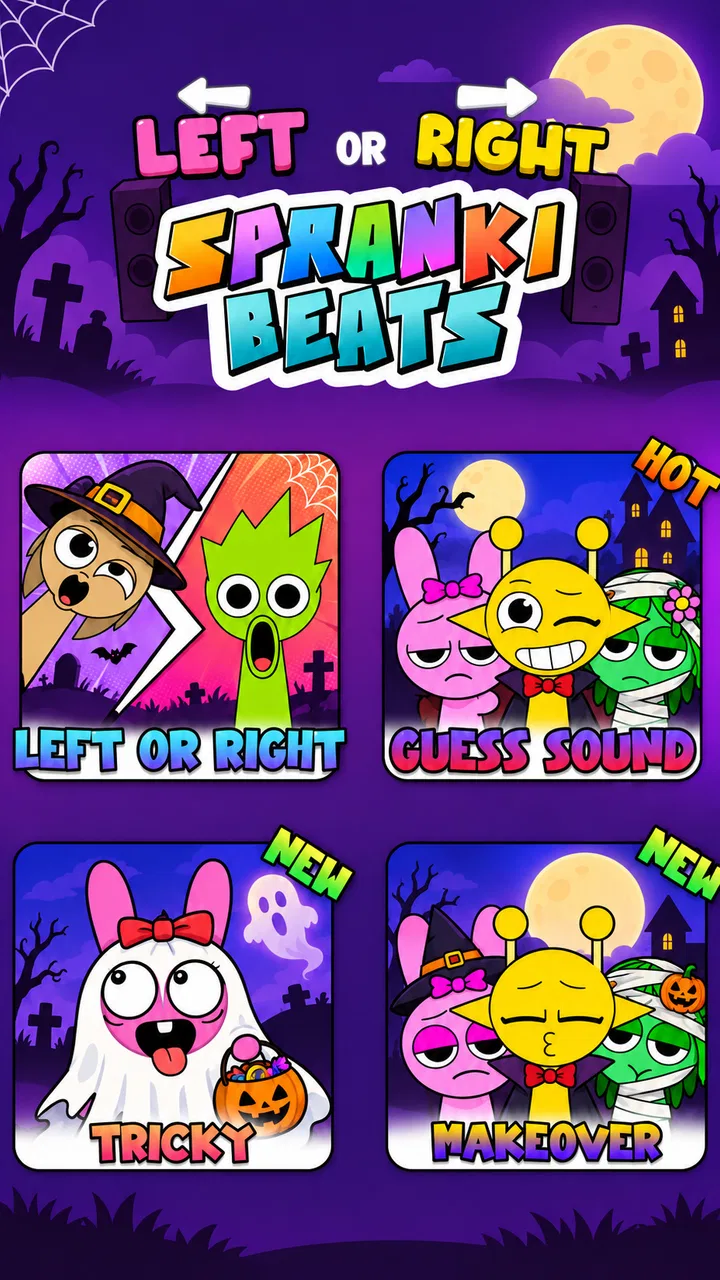
Left or Right: Monster Beats
- 4.3
- Rating
- 1.00M
- Installs
- Free
- Price

 Analysis by App-foxy
I approached Left or Right: Monster Beats as a quick music game rather than a traditional rhythm-training tool. Its basic appeal is immediate: you respond to beats, try to stay in time, and gradually become more comfortable with the game’s musical patterns. That makes it easy to understand in a spare moment, but the simple premise still leaves room for mistakes, learning, and small improvements from one attempt to the next.
The game comes from Goblin Game and is available free of charge. It is listed for everyone, so the presentation is aimed at a broad audience rather than a narrowly defined age group. The combination of a music-focused format and a short, reactive control idea makes it particularly approachable for someone who wants something lighter than a large action game or a complex music simulator.
My first impression was that the game is best enjoyed with the right expectations. You are not opening a full music-production application, and you are not replacing a formal rhythm course. You are opening a compact game built around attention, timing, and the satisfaction of getting a response right. The first meaningful goal is not a perfect run; it is learning to recognize the beat and react without rushing.
You May Also Like

 Blood Strike: 2.5 Anniversary
Blood Strike’s Loadouts Turn Every Drop Into a Tactical Gamble
A close look at Blood Strike’s custom loadouts: how fast access to signature weapons reshapes its battle royale rhythm, rewards preparation, and narrows the gap between fights.

 Pandora - Music & Podcasts
Pandora’s Music Is Easy to Start, but Harder to Recover
Pandora’s strength is its low-effort path from a seed to a station. Its weak spot is how much confidence it asks you to place in connection, setup, and quiet recovery.

 8 Ball Pool
 Is Built on Rivalries, Rematches, and Routine
A close look at the rivalries, rematches, shared routines, and unanswered safety questions that turn a quick pool match into a persistent mobile community.

 Samsung Music
’s Quiet Strength Is Playing What You Already Own
Its reach comes less from spectacle than from dependable access to a personal library. That simplicity is both the app’s strongest retention engine and its ceiling.

 AccuWeather: Weather Radar
AccuWeather Review: A Quick, Clear Forecast for Everyday Decisions
For everyday plans, the best forecast is the one you can understand quickly. AccuWeather makes rain timing, radar, and local conditions easy to act on, with a few trade-offs.

 Hill Climb Racing
Why Hill Climb Racing Still Turns Crashes Into One More Run
A tiny car, a bumpy hill and one more upgrade: Hill Climb Racing keeps resurfacing because its simple chaos makes every near-miss feel personal.
More From Our News Desk



Getting comfortable with the rhythm before chasing a high score
The title suggests a left-or-right decision, so the most important adjustment for a new player is to think in terms of timing and direction together. At first, I found it tempting to focus only on which side to choose. That approach makes the music feel like background noise. A better method is to listen for the pulse first, then treat the visual choice as confirmation of the action you need to make.
This distinction matters because rhythm games often punish a player who watches the screen too intensely. When I stared only at the moving visual cues, my reactions became late or hurried. When I allowed the beat to guide my attention, the choices felt less random. The game becomes more enjoyable once the player stops treating every input as an isolated test and starts noticing the repeating musical flow.
For a first session, I would use a quiet place and headphones if they are comfortable for you. That is not because the game requires a special setup, but because outside noise can make a timing-based experience feel harder than it really is. If you are playing in a busy room, you may blame your reactions when the real problem is that the beat is difficult to hear consistently.
The game is also a natural fit for short breaks. I would play it while waiting for an appointment, taking a brief pause from work, or looking for something more interactive than scrolling. Its appeal is strongest when you want a focused activity that can be understood quickly. Someone searching for a long story, deep character progression, or a broad collection of modes should look elsewhere in the music-game category.
What the first launch feels like
Because this is a game with a straightforward central idea, I did not need to spend a long time learning a complicated interface before trying it. The useful mindset is to treat the opening attempt as practice, even if the game presents it as a normal round. You are learning the relationship between the audio, the visual prompt, and your own finger movement.
On a phone, I recommend holding the device in a way that leaves both response areas easy to reach. Avoid gripping it so tightly that your thumb has to travel across the screen. A small change in hand position can make a surprising difference when the game asks for quick alternation. I also found that keeping the device stable is more helpful than trying to make dramatic swipes or exaggerated taps.
Before starting, make sure the sound is at a level where the beat is clear but not uncomfortable. If the audio is too quiet, you may rely entirely on visual timing and feel that the game is inconsistent. If it is too loud, fatigue arrives quickly and the music stops helping. A moderate volume gives you a better chance to use both senses together.
The current version is 1.0.7, and the game supports devices running Android 7.0 or later. That makes it accessible to people using older compatible Android phones, although the experience can still vary depending on the device, its speaker quality, and how responsive the touchscreen feels. I would check the operating-system requirement before planning to play on an older spare phone.
Your first successful action
For the first successful attempt, I would ignore the urge to play quickly. Listen to a few beats and identify the regular pulse. Then make the next response as calmly as possible. The goal is to connect one correct action to the sound rather than to chase a long sequence immediately. Once that connection feels natural, the rest of the round becomes less intimidating.
A useful technique is to keep your eyes slightly ahead of your finger. Watch for the next cue while your hand completes the current response. Looking down at the exact point of contact after every input creates a tiny delay, and those delays accumulate. This is one of the less obvious lessons of the game: your attention should be split between the present action and the next beat, not trapped on the last mistake.
If you miss, do not restart instantly every time. Let the round teach you what happened. Was the response late because you waited for the visual cue to become obvious? Did you press the wrong side because you anticipated the change? Did the music become harder to follow after several quick inputs? Identifying the type of error is more useful than simply repeating the same movement at greater speed.
I also recommend keeping your first meaningful success modest. Completing a short sequence cleanly is more valuable than producing one lucky response in a frantic run. Once you can repeat that success, you have a dependable starting point. That is when the game begins to feel like a skill you are building rather than a series of guesses.
Where new players can become confused
The left-or-right concept sounds simple, but simplicity can create its own confusion. A player may assume that the correct response is based only on the position of a visual object, while the real challenge is the combination of position and musical timing. If your choices appear correct but the results remain inconsistent, slow down and ask whether you are responding on the beat or merely reacting when the screen looks obvious.
Another common mistake is changing technique after every miss. One attempt uses fast taps, the next uses broad movements, and the next relies on watching only the screen. That makes it difficult to know what actually improved. I prefer to change one variable at a time: keep the same hand position, listen more carefully, or delay the response slightly. This turns each round into a small experiment.
Players can also confuse a difficult sequence with a problem in their own ability. Music games often feel easy for several moments and then suddenly demanding. In this title, that contrast is part of the learning curve. When the rhythm becomes less comfortable, returning attention to the pulse is more productive than staring harder at the prompt.
There is a practical reason to take breaks as well. Repeated misses can make your hands tense, which slows the very reactions you are trying to improve. I found that stepping away for a few minutes can be more effective than forcing another attempt. When I returned, the same pattern was easier to read because I was no longer anticipating failure.
Turning a casual round into a useful routine
For someone new to rhythm games, I would use a three-stage routine. First, play one round without trying to optimize anything. Second, replay while concentrating on hearing the pulse before each response. Third, change your hand position or device angle only if the controls feel physically awkward. This sequence separates musical understanding from physical comfort, two problems that are easy to mix together.
This routine is especially useful on a small phone. Limited screen space can make left-and-right actions feel crowded, and a case with raised edges may affect how comfortably your thumb reaches the response areas. If your phone feels cramped, rotate your grip rather than pressing harder. The game’s quick decisions reward relaxed movement more than force.
Another helpful habit is to stop after a clean improvement instead of continuing until frustration takes over. If you finally complete a sequence that previously caused trouble, that is a good place to pause. Ending on a clear success gives you a reference point for the next session. It also keeps the game connected with progress rather than with endless repetition.
For younger players, the everyone rating makes the game easier to consider as a shared casual activity, but I would still introduce it as a timing game rather than a competition. A child who enjoys music and quick choices may find it inviting. A child who dislikes repeated retries or reacts badly to missed inputs may prefer a less demanding puzzle or a game with slower decisions.
How it compares with other music games
Compared with music apps that let you create or mix tracks, this game is much more focused on reacting. You are not opening it to arrange a song, adjust a virtual instrument, or learn production techniques. Its strength is the short feedback loop: hear the rhythm, choose a response, and immediately see whether your timing worked.
It also differs from large rhythm games that depend on extensive song libraries, elaborate progression systems, or many layers of customization. Those alternatives may offer more variety for a committed player, especially someone who wants a long-term collection of music challenges. Left or Right: Monster Beats is better suited to a player who values a clear central action and does not need a large surrounding system to stay interested.
That focus is both its advantage and its limitation. A beginner can understand the basic objective without reading a long manual, but an experienced rhythm-game player may want more depth than the compact format provides. If your priority is improving timing in a friendly, low-pressure way, the focused design works well. If you want advanced chart analysis, instrument-specific practice, or a broad competitive scene, another game will probably serve you better.
The free price removes a major barrier to trying it. I could recommend installing it when you are curious about this style but do not want to commit money before understanding whether the controls suit you. Still, free access alone does not guarantee that it will hold your attention for weeks. The right question is whether you enjoy repeating a musical response pattern and refining small timing errors.
Who will enjoy it most
I think the best audience is someone who wants a fast, approachable music game with a simple decision structure. It can work for a first-time rhythm player because the core idea is easy to explain. It is also suitable for experienced players who want a lighter change of pace between more demanding games.
It may be a good choice for families looking for an everyone-rated game that encourages attention and coordination without requiring a complicated story. It can also suit commuters or casual players who prefer short sessions. The important condition is that the player enjoys repetition. Improvement comes from noticing timing habits and trying again, not from unlocking a completely different activity after every attempt.
I would be more cautious about recommending it to someone who wants a calm, passive music experience. This is not the right choice if you mainly want to listen without interacting. I would also point a highly competitive rhythm specialist toward a deeper alternative if they need extensive customization, demanding technical charts, or a more developed progression structure.
The game has already attracted over a million installs and holds an average rating of 4.3 from around one thousand three hundred ratings. Those figures suggest that the basic idea has found a sizeable audience, but they should not replace your own test of the controls. Timing games are unusually personal: a layout that feels natural to one player can feel awkward to another.
Small adjustments that make the first sessions better
My first practical tip is to use a consistent playing position. Switching between one-handed play, two-handed play, and a flat phone on a table makes your movements less predictable. Pick the arrangement that lets you reach both sides without stretching, then keep it for several rounds so your hands can learn the distance.
My second tip is to treat sound as an active guide. Do not wait for the visual cue to become completely clear if doing so makes you late. Use the music to prepare your response, while the screen tells you which side to use. This is more demanding at first, but it is also the approach that makes the game feel less like visual guessing.
My third tip is to diagnose misses by rhythm rather than by emotion. A late response, an early response, and a wrong-side response require different corrections. If you label every failure as simply “bad,” you lose useful information. If you can name the error, you can make a targeted adjustment on the next attempt.
A fourth tip is to protect your attention. Notifications, conversation, and background video can make a short rhythm round feel unfair. Put the phone in a quiet mode for a few minutes if you are serious about testing your ability. This is especially important when deciding whether you truly dislike the game or were simply playing under distracting conditions.
What to expect after the first few sessions
After the novelty fades, the question becomes whether the basic action remains satisfying. In my experience, the answer depends on how much you enjoy incremental improvement. The game is not strongest as a one-time curiosity; it is more rewarding when you notice that a pattern which once caused hesitation now feels familiar.
That does not mean every session will feel better than the previous one. Some days your timing will be less reliable, particularly when you are tired or distracted. I would judge the game over several short sessions rather than one frustrating attempt. A music game can expose changes in concentration that have little to do with the quality of the game itself.
The developer, Goblin Game, has positioned this release around a very readable musical interaction. That clarity is useful for newcomers, but it also means the game has to earn continued attention through the feel of its timing rather than through a complicated feature list. If the central response loop feels satisfying in your hands, the simplicity becomes a strength. If it feels repetitive immediately, additional practice may not change your opinion.
The release date was March 21, 2025, and the current version remains a relatively early point in the game’s life. I would approach it as a focused experience that can be enjoyable now, rather than assuming it should already match the breadth of long-established rhythm titles. The most sensible test is simple: install it on a compatible device, play with audible sound, and give yourself enough attempts to learn the timing before deciding.
My recommendation for a first-time player
I recommend starting with a short, deliberate session instead of trying to master everything immediately. Find a comfortable grip, set a moderate volume, listen for the pulse, and aim for one clean sequence. When you miss, identify whether the problem was timing, direction, or tension in your hand. That process gives you a fair impression of what the game is asking from you.
For me, the strongest part of Left or Right: Monster Beats is its accessibility. It presents a music-game challenge without demanding that a new player understand a large collection of systems first. The trade-off is that players looking for extensive content or advanced competitive depth may find the focused design limited.
As a free music game for everyone, it is easy to try and easy to explain to a friend. I would recommend it to casual players, beginners, and anyone who likes the satisfaction of correcting a small timing mistake. I would skip it in favor of a fuller rhythm title if your priority is a large song catalog, deep customization, or long-form progression.
My final view is positive but measured: this is a good choice when you want a direct, beat-driven challenge that can fit into everyday breaks. Give the rhythm your attention, keep your movements relaxed, and judge the experience after you have learned the basic timing rather than after a single rushed attempt. That is when the game’s simple idea has the best chance to become genuinely enjoyable.
FAQs for Left or Right: Monster Beats
01What is the main objective of Left or Right: Monster Beats?
Left or Right: Monster Beats is a rhythm-based game where players must quickly decide which direction to swipe to match the beat of the music. The primary objective is to follow the rhythm as accurately as possible, improving your timing and reflexes while enjoying a unique musical experience.
02Is Left or Right: Monster Beats suitable for all ages?
Yes, Left or Right: Monster Beats is designed to be fun and engaging for players of all ages. The game features a simple interface and easy-to-understand mechanics that make it accessible to both younger audiences and adults who enjoy rhythm games.
03Does Left or Right: Monster Beats require an internet connection?
While Left or Right: Monster Beats can be played offline, an internet connection is needed to access certain features such as downloading new music tracks and participating in online leaderboards. Playing online enhances the experience by offering more content and competition.
04Are there in-app purchases in Left or Right: Monster Beats?
Yes, Left or Right: Monster Beats offers in-app purchases. Players can buy additional music tracks, power-ups, or cosmetic items to enhance their gameplay experience. While the game is free to download, these purchases can provide added value and customization.
05What platforms is Left or Right: Monster Beats available on?
Left or Right: Monster Beats is available for download on both Android and iOS devices. This ensures that users can enjoy the game on a wide range of smartphones and tablets, making it accessible to a broad audience of mobile gamers.
Pros
- Engaging rhythm-based gameplay.
- Wide variety of challenging levels.
- Colorful and vibrant graphics.
- Intuitive controls for easy play.
- Regular updates with new content.
Cons
- Occasional in-app purchase prompts.
- Ads can be distracting at times.
- Limited offline functionality.
- Some levels feel repetitive.
- Requires a stable internet connection.

Left or Right: Monster Beats
Gallery